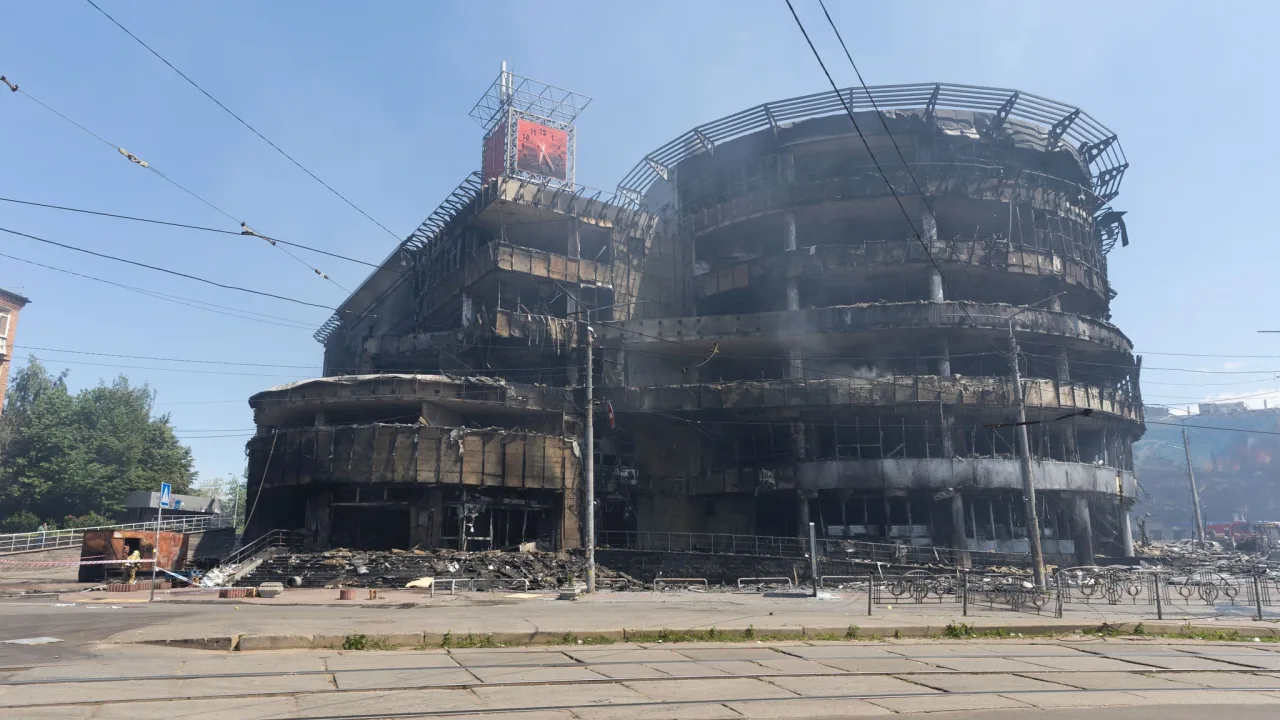
Since 10 September the shopping centres of Bucha and Irpin have lived by a new scheme: during a “yellow” alert they stay open, during a “red” one they close and send people to shelters. The scheme looks simple, but behind it lie a resolution that does not contain the word “retail” at all, a region and a district that adopted no rules of their own for malls, and two announcements by the shopping centres themselves in which the shelter is named as a basement and “the nearest one”.
This is set out in Cabinet of Ministers resolution No. 1092 of 4 September 2026, in force from the day of publication.
We have gathered everything officially known as of 11 September and worked out what it means for a shopper, a shop assistant and an owner. The impetus for the resolution was not the strikes on shopping centres but the opposite — alerts that were stopping trade: at the end of August sirens in Kyiv covered up to 68% of malls’ working hours, and on 31 August the capital’s Defence Council proposed to the government “a different algorithm for the work of business”.
On 2 September the President instructed that “clear criteria to enable the work” of business during the yellow level be set, on the evening of 3 September Prime Minister Serhii Koretskyi explained the logic — “the economy has to work, taxes have to reach the budget” — and the resolution was signed the next day. The wave of drone strikes on malls themselves fell on those same weeks, and that is the main contradiction of the new rules, to which we return below.
What the resolution says — and what it does not
The resolution does two things. First, it splits the “Air raid alert” signal into two levels: red — a missile, missile-and-drone or massed drone threat; yellow — a drone threat. Second, it allows business to operate during the yellow level, but on one condition: only where there is “a temporary or permanent shelter for staff and visitors”. Where there is no shelter, work is allowed “by agreement with the workforce”, and for no longer than three months — that is, roughly until the beginning of December.
Visitors’ presence in such a place, verbatim, “is at the visitors’ own discretion”.
But there is no rule saying “red level — everyone closes” in the text of the resolution. The red level is mentioned there only in relation to the metro. The formula “the red level will mean a stop to work and a mandatory move of people to shelters” appears only in the government’s statement of 3 September and in the Prime Minister’s words. The words “mall”, “retail” and “mass presence of people” are not used in the resolution at all: it is written for all “business entities regardless of the form of ownership”.
Two more gaps are visible from the text. The terms “temporary shelter” and “permanent shelter” do not exist in the Code of Civil Protection — the Code knows a bomb shelter, an anti-radiation shelter, a dual-purpose structure, a mobile shelter and a basic shelter. And the “maximum blast overpressure indicator” for the yellow level, on which depends what counts as a shelter at all, was to be set by the Ministry of Defence and the General Staff within ten days — roughly by 14 September.
The separate government decision on “the specifics of the activity of certain business entities” that the resolution promises had not been published as of 11 September.
On 10 September, after a meeting with major retailers, Koretskyi wrote that the government had adopted “recommendations taking into account differentiated alerts” and given business three months for “shelters/safe spaces at places where services are provided”. No separate document with these recommendations is publicly available yet.
Kyiv and the region wrote no rules of their own for malls
Kyiv’s Defence Council met on 7 September. Vitali Klitschko announced a curfew from 01:00 to 05:00 from 10 September and added: “The opening hours of catering establishments, entertainment venues and malls do not change.” An hour later came a clarification: business entities operate “in accordance with the government’s decision”.
In the Defence Council’s protocol No. 5 itself there is not a single point about retail in the context of alerts, only an instruction to “urgently” develop safety protocols for the yellow and red levels. In other words, the regime the Kyiv malls live by is their own decision taken to implement the resolution, not a city requirement.
The Kyiv region is the same. The regional Defence Council on 8 September, according to Tymur Tkachenko, synchronised the curfew with Kyiv, tightened requirements for petrol stations and decided to work with Ukrzaliznytsia on placing mobile shelters at railway stations. Nothing about malls, markets or retail in the published part of the decisions; the only published act following the meeting is order No. 1999 on the curfew.
So far the region has approved systematic rules for the duration of alerts only for petrol stations. Back on 4 September the administration reported meetings “with owners of retail and warehouse space, retailers” and launched a “single window” for entrepreneurs, but did not disclose what was agreed.
Over the whole week the Bucha District Administration only forwarded others’ posts — the government statement, the regional administration’s posts on the “single window” and the regional Defence Council — and reminded of the curfew with permission to move to the nearest shelter. Bucha and Irpin city councils published no decisions of their own on retail.
Tellingly, the Bucha city council channel, which has marked alerts with a colour since 9 September, writes the same thing even under a yellow signal as under a red one: “proceed immediately to the nearest shelter”.
In practice the new system has worked for the district since 8 September: the first “yellow” for the Bucha district appeared in the Kyiv Regional Military Administration’s channel that day, the first “red” — on 9 September at 23:24, a missile threat. Over two and a half days, from the evening of 8 September to 15:30 on the 11th, we counted 16 yellow alerts for the district in the administration’s feed and only 2 red ones.
If the proportion holds, under the new rules the district’s shopping centres will stay open during most alerts.
Two shopping centres in the district have announced their rules
On the evening of 10 September the Bucha Passage shopping centre at 66-A Levka Lukianenka Street published its rules. Yellow level: “Bucha Passage continues to work! However, each shop, department or establishment decides for itself whether to serve visitors at this time, so some locations may be closed.” Red level: “Bucha Passage suspends its work, visitors must proceed to a shelter.” The shelter is named specifically: “The nearest shelter is located in the basement of the shopping centre.”
The same evening Giraffe Mall in Irpin at 160 Soborna Street — the shopping centre rebuilt after its destruction in 2022 — posted an infographic. Yellow level: “Shops and establishments in Giraffe Mall may work as usual or decide for themselves.” Red: “Giraffe Mall temporarily stops working. We ask all visitors to move immediately to the nearest shelter.” Where exactly that nearest shelter is, the announcement does not say.
 Photo: Giraffe Mall / Facebook
We found no announcements from other retail sites in the district — City Mall in Irpin or the chain supermarkets in Bucha: as of 11 September the Silpo, NOVUS, ATB and Epicentr chains had not published rules by level on their official pages.
Now about shelters. The list of protective structures registered with Bucha city council contains 19 sites for a total of 6,558 people, and not a single shopping centre or shop among them: these are structures of the Buchaservice utility, of enterprises, and of the school and kindergarten in Havrylivka. The closest anti-radiation shelter on the list to the Passage is at 17 Heroiv Maidanu Street, designed for 500 people.
The basement of the shopping centre itself, which the Passage calls a shelter, is not on this list of bomb and anti-radiation shelters — so it has no status as either; whether it is registered as a basic shelter cannot be seen from open data. In Irpin the city council keeps a map of shelters with underground car parks, but it does not tie any shelter to a specific shopping centre.
How the Kyiv malls closest to the district did it
The Kyiv malls closest to the district, and several of the largest, announced their rules on 8–10 September, and they differ noticeably precisely in what to do at red.
Retroville in Vynohradar — the nearest large mall to Kotsiubynske — refers directly to the resolution and writes that visitors’ presence during the yellow level “is at their own discretion, with an understanding of all possible risks and consequences”, and that “the officials of MARTIN LLC and the administration of the RETROVILLE mall bear no responsibility for people’s life and health”. At red the mall closes; shelters are on the maps in the Kyiv Digital app.
If an alert continues after 21:00, only the NOVUS hypermarket and the checkout area operate.
Lavina Mall in Novobilychi stops work at red, and visitors must “immediately leave the shopping halls” and exit the mall — the announcement names no shelter of its own. DREAM in Obolon “completely stops its work” at red and sends people to the Minska, Obolon and Heroiv Dnipra metro stations; at yellow each tenant decides for itself, and the mall publishes the list of those closing separately. River Mall on the left bank has a temporary shelter on the second level of its underground car park.
And only Ocean Plaza at Lybidska does not close at any level: during an alert a “safe space” operates there on level −1 — Auchan, shops, cafés and the car park.
Kyiv’s municipal sector took a stricter path. From 10 September the pharmacies of the Farmatsiia utility stop work immediately at the red level, and everyone present must go to a shelter. Cultural institutions do not start an event at red, and stop one that is under way and lead people out — on the basis of Ministry of Culture order No. 1095 of 9 September.
This is the sectoral document closest to the cinemas and entertainment zones in malls, and in it the rule on the red level is spelled out explicitly — unlike in the resolution.
Why it is the “yellow” threat that hits shopping centres
The main tension in the new rules is that permission to operate has been given precisely for the type of threat that has hit shopping centres most often in the past two weeks. On the evening of 9 September in Sumy a drone hit a mall: according to the State Emergency Service, two dead and 14 injured, three of them children.
On 10 September, in the middle of the day, a strike on retail sites in the centre of Pavlohrad: the State Emergency Service first reported two dead and 18 injured; in the evening the President named four dead and more than 60 injured — people “who were simply near shopping centres” — and later the Dnipropetrovsk Regional Military Administration updated the toll: five dead, 67 injured, eight of them children. The same week drones hit shopping centres in Mykolaiv, Pryluky and Zaporizhzhia.
All of this is a “drone threat”, that is, the yellow level, at which malls now stay open.
The most important figure in this story comes from Kryvyi Rih, where on 21 August a strike on one of the city’s largest malls took 16 lives. Interior Minister Ivan Vyhivskyi reported: “About 20 minutes passed between the moment the air raid alert was declared in the city and the first drone hit.” A supermarket in that mall kept working despite the local authorities’ warnings, “a significant number of the dead were found precisely there”, and the supermarket’s director was served with a notice of suspicion.
Twenty minutes is enough time to reach a shelter, if you do not wait.
The Bucha district is not outside this wave either: on 31 August drones attacked the distribution centre of one of the retail chains in the district, and from the evening of 10 September and all through the night to the 11th warehouses burned and the rescuers were struck a second time. The district’s distribution centres and warehouses are already under fire.
Who is responsible if disaster strikes
The answer is unexpected. The State Labour Service acknowledged in writing last year: “Ukrainian legislation currently in force does not provide for direct liability for an enterprise operating during an air raid alert.”
There is only the employer’s general duty under Article 153 of the Labour Code not to demand work that poses a clear danger to life and, as the same service explains, the possibility of holding officials liable under Article 41 of the Code of Administrative Offences or Article 271 of the Criminal Code if they failed to take safety measures and this caused harm. In Kryvyi Rih the supermarket director was served with a notice of suspicion for official negligence.
So Retroville’s disclaimer of responsibility “for people’s life and health” is not a legal fact but a position. Article 20 of the Code of Civil Protection obliges sites where large numbers of people are present to provide collective protection for both staff and visitors and to organise their evacuation.
And the Ministry of Justice reminds of the penalties: for failing to provide access to a shelter — a fine of 1,700 to 3,400 hryvnias; for violating the operating conditions of a shelter — 2,550 to 5,100, up to 8,500 for a repeat within a year; and if denial of access led to injury or death — three to eight years in prison.
What about shop assistants and cashiers
For those behind the counter, the new rules added nothing and took nothing away. The employee’s right to go to a shelter remains: under Article 153 of the Labour Code an employer may not demand dangerous work, and the Ministry of Justice states outright that leaving the workplace during an alert is not absenteeism, including the time to get to the shelter and back.
A demand to stay at the workplace without the possibility of moving to a shelter is unlawful; complaints can go to a trade union, the State Labour Service or the police.
Money is the only real conflict. The State Labour Service treats time in a shelter as downtime through no fault of the employee, paid at “no less than two thirds of the wage rate… (salary)”, and applies average earnings only to a “production situation”. The Ministry of Justice in its guidance says otherwise: the employee “retains average earnings”.
For a shop assistant on a fixed salary, that is a difference of a third of their pay for every hour of an alert — and, as we will see below, there are now many such hours.
And one more thing nobody has explained: how exactly the “agreement with the workforce” is formalised, without which a place with no shelter may not operate. A meeting? Minutes? A trade union? The State Labour Service has published no clarification since 4 September; trade unions and retail associations have expressed no public position on the resolution.
Tellingly, back in 2024 the State Labour Service quoted the then deputy minister Tymur Tkachenko — now head of the Kyiv Regional Military Administration: “It is sheer madness to demand that people come to work when there are explosions everywhere.”
The price of downtime
How much an hour of a closed mall costs, no industry association has calculated in hryvnias. But the Ukrainian Council of Shopping Centres measured the time: in August 2026 alerts sounded during 21.8% of shopping centres’ working hours — a record, against 9.4% a year earlier. Average forced downtime was 6.4 working days in August and 166.8 working days since the start of the full-scale invasion; the biggest rise was in Kyiv and the Kyiv region.
In the capital the share grew from 3.3% in July to 11.6% in August, and on 27 August sirens covered 68% of malls’ working hours. The council estimates direct damage to retail property from strikes this year at more than 3.2 billion hryvnias — and downtime is not included in that sum.
What this looks like at the level of a single tenant was shown by the Pesto Cafe chain: from 3 September it temporarily closed 7 outlets in malls in Kyiv and its suburbs, among them one in Chabany just outside Kyiv; it named “constant air raid alerts and the difficult security situation” as the reason.
A short guide for visitors
Find out the level. The Kyiv Regional Military Administration’s channel since 8 September and the Bucha city council’s channel since 9 September mark the colour: 🟡 — drones, 🔴 — missiles or a massed attack. In Kyiv itself differentiated alerts have operated since 6 September, but not in the Pecherskyi district and only partly in the Holosiivskyi and Sviatoshynskyi districts — there the siren is the ordinary one.
Yellow level. The mall is most likely open, but you are there at your own discretion — that is what the resolution says. So the first thing to do, right at the entrance, is to work out where the shelter is: at the Passage it is the basement of the centre; at Giraffe Mall you need to ask security or the administration where exactly they lead people. Individual shops may be closed.
Red level. Leave at once, without waiting for the receipt to be printed. The State Emergency Service reminds: by the stairs, not the lift, following staff instructions; return only after the all-clear.
Maps. Bucha — the interactive map of protective structures on the city council website and the list mentioned above; Irpin — the “Shelters” section on the city council website; Kyiv — Kyiv Digital and Diia.
What else has to change
The resolution set off a chain of decisions, most of which are still ahead. The Ministry of Defence has to set the blast overpressure indicator for the yellow level — on it will depend what counts as a shelter at all. The government promises a separate decision for “certain business entities”. Kyiv has ordered safety protocols for both levels. The three months given to businesses without shelters run out at the beginning of December.
The Ministry of Culture has already issued its document; the State Labour Service, the Ministry of Economy and the regional authorities have not yet. We will follow each of these steps.
As a reminder, earlier today we looked at what drivers in the Kyiv region should do at petrol stations during an alert — petrol stations have become a separate target for drones, and the region approved rules for them before it did for shopping centres.
Nota bene
Bucha FM is an independent news site and station for the Bucha district. We cover what matters to the community, and we work for you — and because of you. Joining the people who make this possible is simple: support us with any amount.

Comments
No comments yet — be the first.