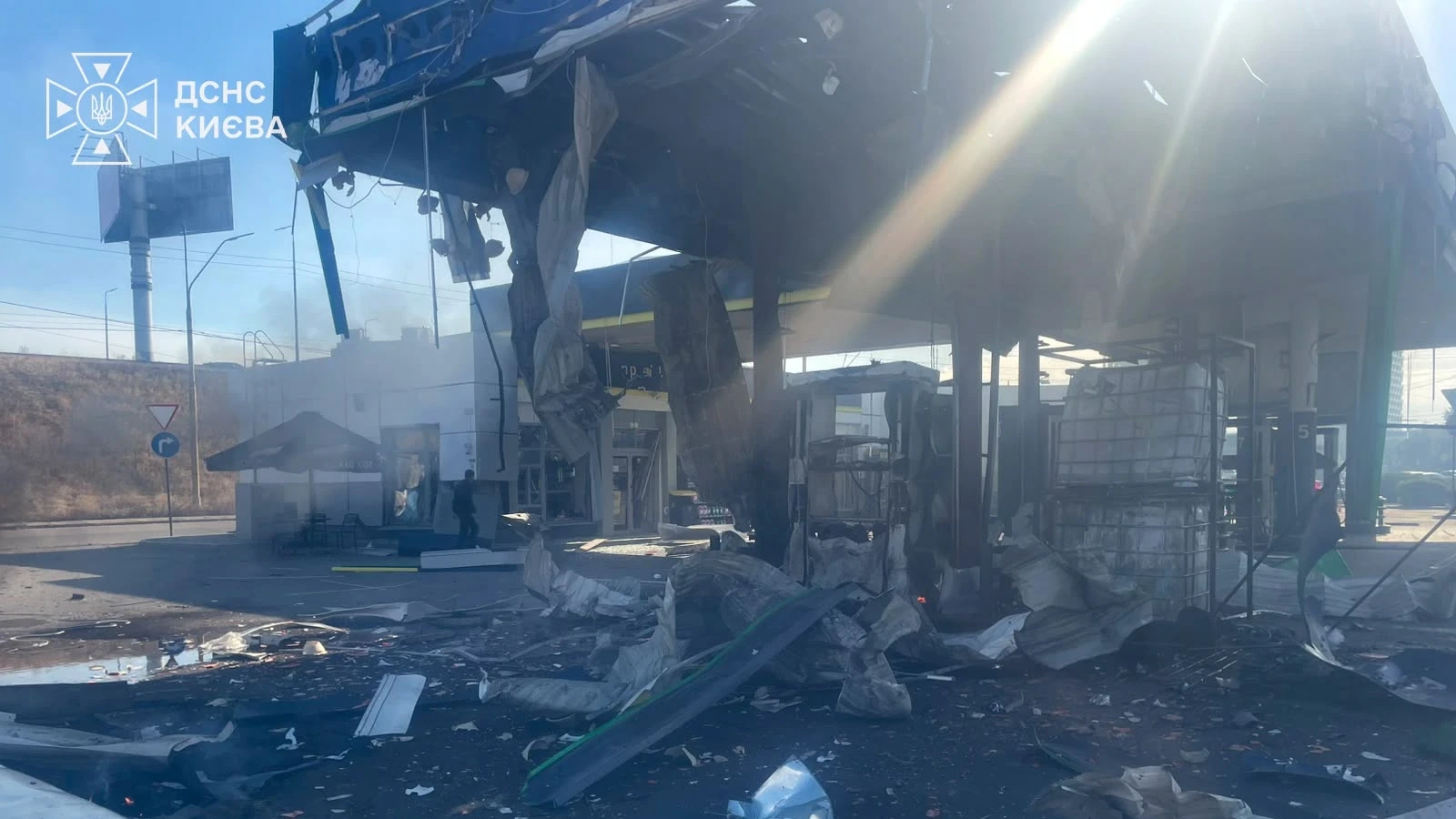
This morning russian jet drones struck two petrol stations in Kyiv — one of them twice. Two people were killed and eight injured, among them a rescuer. Yesterday another station in the capital was hit. Before that, filling stations burned in the Boryspil and Obukhiv districts.
Kyiv is not formally our district. But the drones flying at the capital from the north and west pass over the Bucha area, and the M-06 and M-07 highways with their filling stations are our daily road. So this is not a chronicle of someone else’s misfortune, but a warning.
What happened today
At 09:51 Vitali Klitschko reported a hit on a petrol station in the Dniprovskyi district and, immediately after, a second station in Obolon. At 10:07 came a repeat strike on the same Obolon station. Both were Ukrnafta stations, in Troieshchyna and at Pochaina.
It was the repeat strike that injured a rescuer — this was reported by the Kyiv emergency service, not the city authorities. As of 11:58 Klitschko gave the toll: two dead, eight injured, six of them in hospital.
Yesterday, 10 September, the pattern was the same: a drone fell on a petrol station in the Holosiivskyi district, and after a repeat hit the diesel generators caught fire. Four people were injured.
The detail that lives depend on
On both days the stations stopped work at the alert signal and people left them. Serhii Fedorenko, acting head of Naftogaz, wrote that after the signal the stations ceased operations and staff and customers left the premises. Bohdan Kukura, head of Ukrnafta, confirmed the same about yesterday’s attack.
And now the main point. Kyiv police yesterday clarified that all three people injured at the Holosiivskyi station were near it. Not at it — nearby. In other words, the protocol “alert — stop — leave” worked for those who were on the forecourt. The casualties were those who happened to be close by and did not move away.
It is a pattern now
We collected every official report of strikes on petrol stations in Kyiv and the Kyiv region since the beginning of August. The picture is this:
- 5 August, Kyiv — a petrol station damaged, rescuers prevented a gas leak;
- 20 August, Boryspil district — a filling station damaged, six people injured in the district;
- 22 August, Boryspil district, ballistic missile — among the damage a petrol station, 30 lorries and 10 cars; two dead, nine injured;
- 1 September, Obukhiv district — debris from a downed drone damaged a petrol station and 11 private houses, one person injured;
- 4 September, Kyiv region — petrol station equipment among 28 damaged sites;
- 8 September, Kyiv, night attack — a petrol station among more than 50 sites, and emergency service vehicles came under a repeat strike;
- 10 September, Kyiv — a station in the Holosiivskyi district, four injured;
- 11 September, Kyiv — two stations, one of them twice; two dead.
Eight episodes in five weeks, the last three in four days. And that is only the capital region. Across the country it is the same: on 3 August a strike on a petrol station in the Kryvyi Rih district killed three people, including a rescuer and his eight-year-old son; on 24 August russian forces attacked filling stations in the Kharkiv region three times in one day; on 28 August a woman was killed at a station in Kharkiv.
The repeat strike is a weapon of its own
In three of the last four Kyiv episodes there was a second strike on the same spot: on 8 September on rescuers’ vehicles, on the 10th on the generators after the first fire, today on a rescuer. The emergency service has been recording this tactic since last year: Kherson, Zaporizhzhia, Nikopol, Kryvyi Rih.
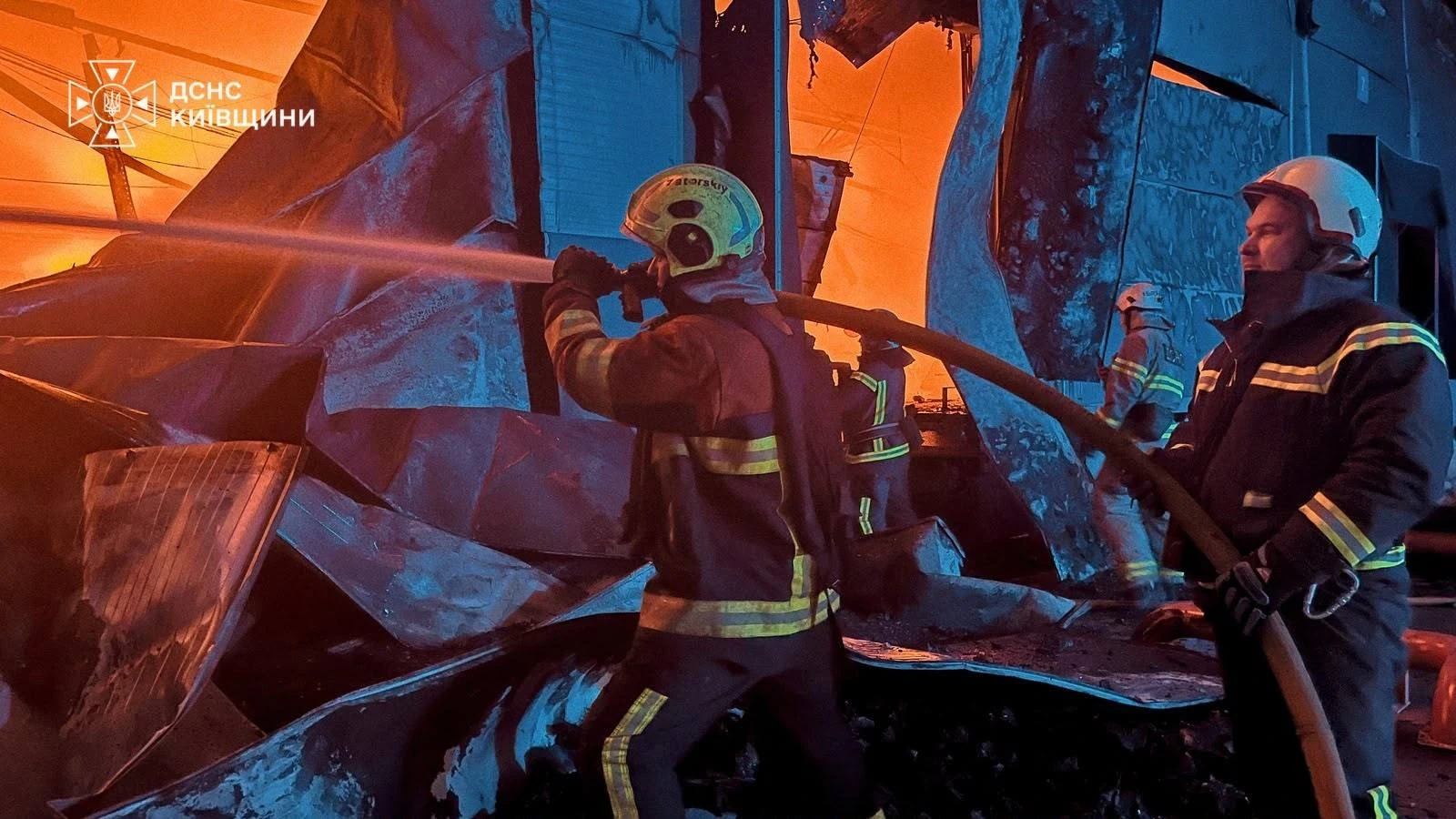
For our district this is no longer theory. On the night of 11 September, while rescuers were fighting a warehouse fire in the Bucha district, the enemy struck again — the Kyiv region emergency service reported it in the morning. It was not a petrol station, but the tactic is the same.
The practical conclusion is simple: the first explosion is not a signal to run and look, film or help. It is a signal that a second one may be coming.
What the region has decided
On 8 September the Defence Council of the Kyiv region decided to tighten the requirements for safety at petrol stations. Tymur Tkachenko named five areas: danger alerts, backup power, fire safety, free access for emergency services and clear access for people to the nearest shelters. All stations, the regional administration writes, will receive clear instructions for alerts; parking will be regulated separately so that cars do not cluster near the tanks.
This is not a reaction to the last two days. Tkachenko held a meeting with market operators, the police and the emergency service as early as 10 August — automated alerts, staff protocols and cars abandoned on forecourts that block evacuation and access to hydrants were raised then.
What the decision does not contain is worth stating plainly. There is no full text of the requirements in the public domain, no date of entry into force, and no word on who will enforce it. And crucially: the regional authorities have not announced any requirement for petrol stations to stop work during an alert. The wording is “to be worked out in the near future”.
Two colours of alert
The general rules for business were set by the government: resolution No. 1092 of 4 September introduced two levels. Red — missile or massed drone threat: work stops, everyone goes to a shelter. Yellow — drone threat: work may continue where there is a shelter for staff and visitors.
Today the yellow level in Kyiv was declared at 09:10, red at 09:46. The first hit on a petrol station came at 09:50. Four minutes. That is the margin you have to count on.
And our district
We found no report of a strike on a petrol station in the Bucha district since the start of August in the official channels of the emergency service, the police, the regional administration and the communities. That is good news, but a temporary one: the district is threaded by the same highways as the Boryspil and Obukhiv districts, and the drones that hit Obolon and Troieshchyna today approached Kyiv precisely from the north.
What to do if the alert catches you at a petrol station
The State Emergency Service of Ukraine has no separate memo for petrol stations — there is a general demand to respond to signals and not to stay near infrastructure sites. The most detailed rules for drivers were published by the emergencies department of Kamianske city council; we have put them together with what the regional authorities and the emergency service say:
- Do not wait at the station. Nozzle back in the pump, engine off, and go. Not to watch your car — to a shelter.
- If you have time — drive away. A forecourt with fuel tanks is the worst place to sit out an alert. Drive off, leave the car and go to a shelter.
- Do not park near the tanks and do not abandon the car on the premises. This is exactly what the regional authorities point to: abandoned cars block rescuers and access to hydrants.
- Do not stand nearby. Yesterday’s casualties in Kyiv were not at the station but beside it. The danger zone does not end at the forecourt boundary.
- After the first explosion — do not go back. The repeat strike comes within minutes. Filming, looking or “helping” — not now.
- Listen to the staff. If the station stops work and asks you to leave, that is not over-caution — it is what saved people on 10 and 11 September.
- Keep the tank at least half full. Then you will not have to fill up at the worst moment.
- If you cannot reach a shelter — a room without windows, two walls between you and the street. This is the basic emergency service rule, and it works at a petrol station too.
One more thing. In Kyiv, from 10 September, the municipal Farmatsiia pharmacies stop work at the red level and take everyone to a shelter. Petrol stations have not yet been obliged to do so. Until they are, it is the decision of everyone holding the pump nozzle.
Earlier we reported that on the night of 11 September a second russian strike hit while rescuers were fighting a warehouse fire in the Bucha district.



Comments
No comments yet — be the first.