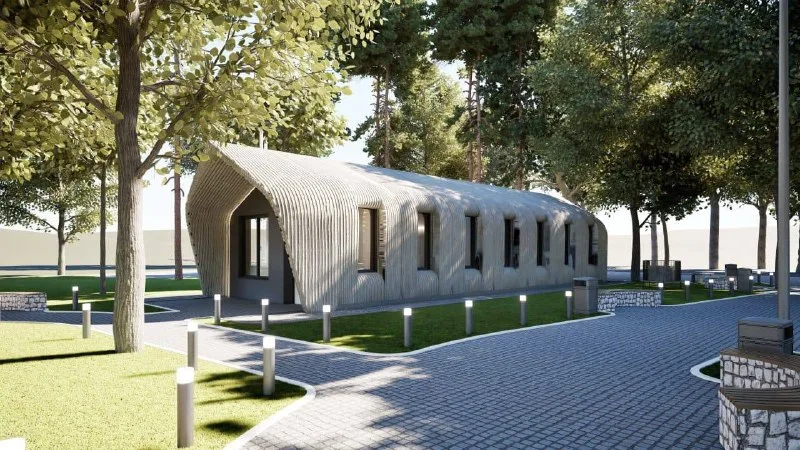
For years the Tarasivskyi neighbourhood of Bucha had no medical facility of its own: to see a family doctor, residents had to travel to another part of town. Now an outpatient clinic will be built here using three-dimensional printing technology — the walls are formed by a construction printer that lays down a concrete mix layer by layer following a digital model.
This was announced by Bucha City Council, which published visualisations of the future facility on its Telegram channel. The project is being carried out together with the United Nations Industrial Development Organization (UNIDO) and the Japanese company Serendix, which specialises in printed housing.

Two family doctors and a nurse for the whole neighbourhood
Two family doctors and a nurse will see patients at the new clinic. This is primary care: vaccinations, check-ups, management of chronic patients and referrals to specialists. It was precisely this kind of everyday, close-to-home care that Tarasivskyi lacked most, since the journey to the nearest clinic swallowed half a day for residents.
Three-dimensional printing shortens construction time and requires fewer hands than conventional masonry. For a community rebuilding dozens of sites at once and competing for construction crews, that is a tangible advantage. Serendix uses the method in Japan to put up compact houses quickly.

A pump room, a garden and a Japanese touch in the layout
The space around the clinic will be renewed as well. The city council promised to repair the artesian pump room used by residents of nearby streets and to lay out a Japanese-style garden. This means a restrained composition of stones, low trees and pathways — a nod to the origins of the partner company.
The neighbourhood will therefore gain not only a medical point but also a place you can visit with no errand in mind. Tarasivskyi, built up mostly with private houses, has had no public space of this kind until now.

Part of a wider reconstruction programme
The Tarasivskyi clinic adds to the list of facilities Bucha is building with international partners. The community has already restored Vokzalna Street, launched a Central Kitchen supplying meals to schools and kindergartens, and installed solar power plants at critical infrastructure sites.
No completion date or budget has been named so far. The visualisations released by the city show a finished building with a distinctive rippled wall surface — the trace of the printer nozzle, which such projects usually leave exposed.
Comments
No comments yet — be the first.