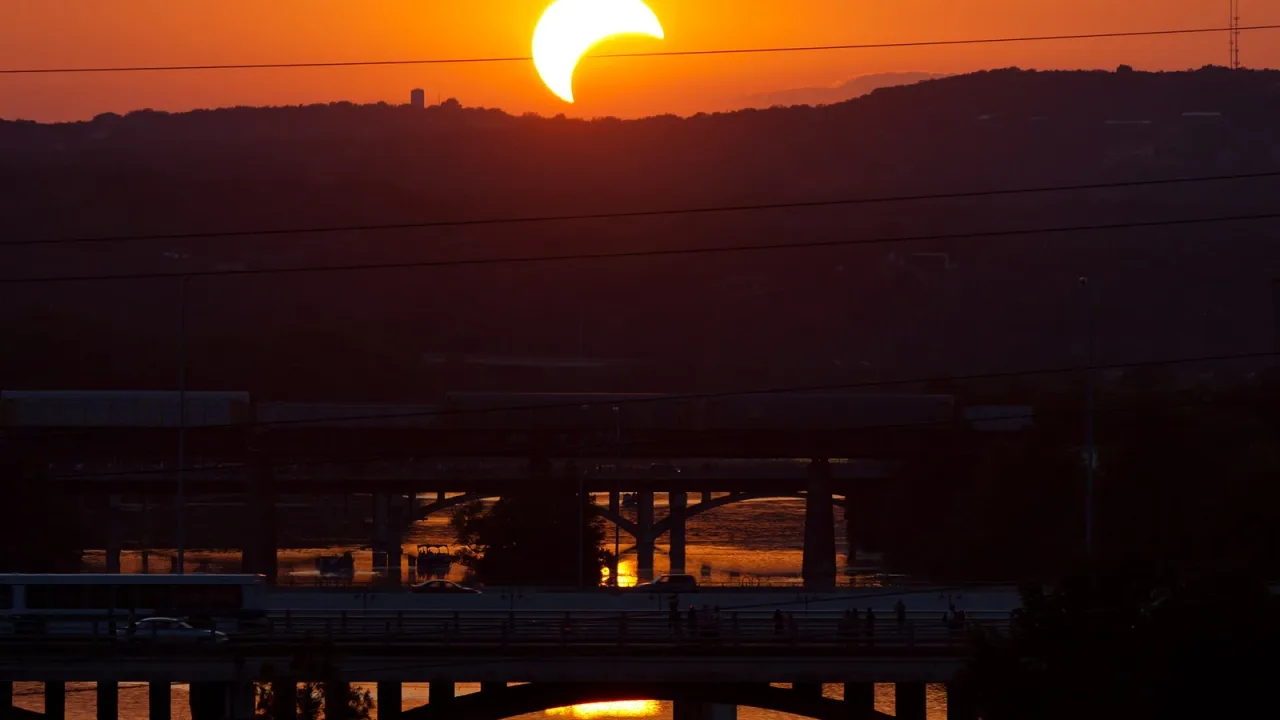
The Moon will pass between the Earth and the Sun and for a few minutes cover the solar disc completely — but only within a narrow band that runs far from Ukraine. The rest of the Northern Hemisphere will see a partial phase: the Sun will look as if a bite has been taken out of it.
We checked the timing and depth of the eclipse for our district against astronomical calculations, and took the data on the path of totality from NASA materials.
When to look in the Bucha district
The partial phase begins at 20:14 Kyiv time. Maximum comes at around 20:20 — and that is where it ends.
The Moon will cover about 13 per cent of the solar disc. That is noticeable if you look carefully and through protection, but not enough to darken the sky or cool the air.
Why only the beginning will be visible
The reason is neither clouds nor the length of the eclipse itself. At the moment of maximum the Sun here will sit exactly on the horizon — its altitude will be zero degrees.
In other words, the eclipse will break off for us not because it ends, but because the Sun sets. So the only chance to see anything is an open western horizon: a field, a high floor, the shore of a lake. From among trees or buildings nothing will be visible.
The west of the country will fare better
The further west, the later the Sun sets — and the more of the eclipse it manages to show. In Kyiv the Moon will cover less than 10 per cent of the disc, in Ternopil about 38, in Uzhhorod nearly 54, and around Kovel more than 57 per cent.
The difference between our district and Volyn is more than fourfold, although it is one and the same event on one and the same evening.
Where the Sun will disappear completely
The path of totality runs across eastern Greenland, the west coast of Iceland, northern Spain and a tiny part of Portugal. In all, around 15 million people will find themselves inside it.
The maximum duration of totality is 2 minutes 18 seconds. In Iceland the Sun will be covered for about two minutes, in Zaragoza for around a minute and a half. The Moon's shadow begins its run at 15:34 GMT.
How to watch without losing your sight
The main rule: never look at the Sun without special protection, even when it is partly covered and seems dim. A retinal burn happens without pain — a person realises what has happened only hours later.
Ordinary sunglasses, smoked glass, X-ray film, CDs and bottle glass do NOT protect. Only special eclipse glasses meeting the ISO 12312-2 standard are safe, or the projection method: make a small hole in cardboard and look at the image of the Sun it casts onto a white sheet.
One more thing: photographing the eclipse on a smartphone without a filter is also a bad idea — the camera sensor is damaged in much the same way as the retina.
Nota bene
Bucha FM is an independent news site and station for the Bucha district. We cover what matters to the community, and we work for you — and because of you. Joining the people who make this possible is simple: support us with any amount.


Comments
No comments yet — be the first.