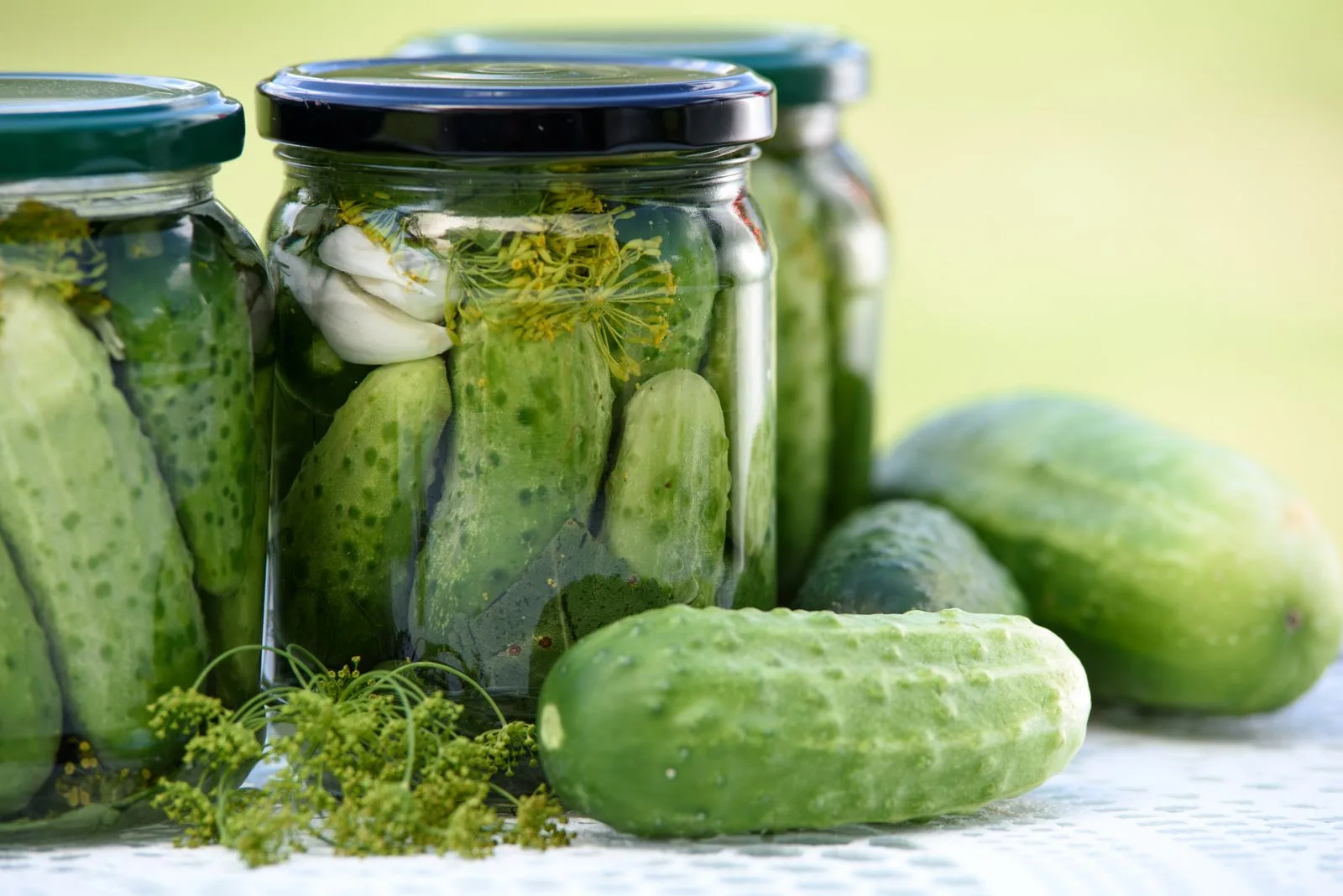
The cold method differs from usual preserving in that the cucumbers are neither boiled nor scalded. They ferment on their own at room temperature, and the preservative role is played by the lactic acid produced in the process.
The recipe was shared by Maryna Harmash in a post in a cooking community.
The author stresses two things that determine the outcome: good salt and cucumbers suitable for preserving. She recommends sea salt only, without iodine — iodised salt hinders fermentation and softens the fruit.
What you will need
The brine ratio for fermentation is 100 grams of salt per litre of water. Be generous with the greens: they give that barrel-cured aroma.
- cucumbers suitable for preserving
- water — 1 litre
- non-iodised sea salt — 100 g per litre of water
- horseradish leaves
- garlic
- cherry leaves
- oak leaves
- blackcurrant leaves
- tarragon
- dill umbels
- amaranth
How to ferment them
- Soak the cucumbers in cold water for two hours.
- Put some of the greens on the bottom of a large pot, pack the cucumbers in tightly and cover with a second layer of greens.
- Pour over salted water at 100 grams of salt per litre.
- Place a small weight on top — an upturned plate is enough.
- Cover the pot with a lid and leave at room temperature.
- Rinse the plate from time to time to remove the film that forms.
- After ten days the cucumbers will be covered with a white film and turn olive-coloured — a sign that fermentation is complete.
The most unexpected step
What follows usually raises the most questions. All the greens and garlic are thrown away — they have done their job. The cucumbers are rinsed and packed into jars, then filled to the very top with clean tap water, with no salt.
The jars are closed with screw lids and put in a cellar or simply in a cupboard in the flat. They can be tasted after a month or two: that is how long the flavour takes to mature.

Comments
No comments yet — be the first.